Wednesday, November 28, 2018

Lepidodendron (scale trees): Link to great blog post on these Carboniferous giants


At the time of this writing, the wallpaper of my blog is a snapshot of Lepidodendron bark. Lepidodendron is an extinct genus of Carboniferous age (358.9-298.9 million years ago [Ma]) giant trees (AKA scale trees) common in swamps that eventually were preserved as major coal deposits. Its stylized bark is quite artistically attractive, rather Art Deco in design.

Yesterday I read a great informative blog post on Lepidodendron (http://www.indefenseofplants.com/blog/2018/11/13/the-rise-and-fall-of-the-scale-trees), describing the growth, reproduction, habitat, and demise of these majestic (100 foot/ 30 meter) land plants. The post includes origin of the bark design:
The name ‘scale tree’ stems from the fossilized remains of their bark, which resembles reptile skin more than it does anything botanical. Fossilized trunk and stem casts are adorned with diamond shaped impressions arranged in rows of ascending spirals. These are not scales, of course, but rather they are leaf scars. In life, scale trees were adorned with long, needle-like leaves, each with a single vein for plumbing. Before they started branching, young trees would have resembled a bushy, green bottle brush.”

That blog post also includes a very sharp photo of Lepidodendron bark, the roots with their own fascinating pattern (stigmaria), and drawings of Lepidodendron species, growth stages, and forest environment.

Below are two photos I took of Lepidodendron for my blog wallpaper. The sample is in the mineralogy collection of the Department of Geology and Environmental Geosciences, Lafayette College, Easton, Pennsylvania. The sample is from the Llewellyn Formation, the younger of two Pennsylvanian-age coal-bearing formations (older= Pottsville Formation) in the eastern Pennsylvania anthracite coalfields. The Pennsylvanian subsystem (323.2-298.9Ma) is the term for the late Carboniferous in North America. The Llewellyn itself was deposited between 308-300 Ma. The Llewellyn Formation also contains the famous St. Clair fossil fern locality. 


For an academic, rather than chatty, description of the St. Clair fossil locality (plus anthracite region mining, stratigraphy, fossils), I recommend two guidebooks: 1) 2015 guidebook to the Southern and Western Anthracite Fields by the Field Conference of Pennsylvania Geologists; Stop 12, page 237, is the St. Clair fossil site; 2) 1992 The Society for Organic Petrology (TSOP) guidebook to The Anthracite Basins of Eastern Pennsylvania (USGS Open File Report #92-568; (https://pubs.usgs.gov/of/1992/0568/report.pdf)); the St. Clair locality is Stop 5, page 65. Both guidebooks include references to Lepidodendron throughout.

Friday, November 9, 2018

Mineral sublimates on steaming culm (coal waste) heaps in NE Pennsylvania: one of Dr. Robert Finkelman’s (USGS) contributions in a career on trace element chemistry in coal


I have been aware of mineral sublimates (materials or minerals formed by direct solid deposition from gas) for a long time from research of friends and colleagues at Dartmouth College on fumarolic sublimates at Izalco volcano in El Salvador. Early collection of minerals there occurred in the 1960’s before and after the 1966 eruption of Izalco*. Vanadates and copper vanadate minerals were found among the sublimates, including several newly identified minerals. For a few of the new sublimates, I, having microscope reflectance measurement experience through coal petrography work, contributed the mineral reflectivity data required for naming new opaque minerals.**

Izalco volcano, El Salvador (this photo and one below from Smithsonian Institution Global Volcanism Program)


On Monday, November 5, 2017, at the annual meeting of the Geological Society of America, I attended the initial biographical presentation by Dr. Harvey Belkin in a session honoring Bob Finkelman (US Geological Survey) for his career in inorganic trace element chemistry of coals and related contributions to the understanding health issues of trace element exposure during mining or home coal use.

Belkin related that one of Finkelman’s early publications (1987; citation below) was on his description of new mineral, downeyite, the first confirmed natural occurrence of selenium oxide. Downeyite is a sublimate formed near a hot gas vent, but not at a volcano: it was found on a burning culm heap in the Northern Anthracite field of Pennsylvania! Piled coal or coal waste can smolder or spontaneously combust. I previously wrote in 2015 about culm heap fires in northeastern Pennsylvania, and evidence that a coal fire in one of the coal bunkers on the Titanic was a possible reason for the speed of passage (easiest way to stop a bunker coal fire is to shovel down and use up coal).

Fell Township, PA, coal waste dump fire, February 2014. (The Scranton Times-Tribune)

Forestville coal dump where downeyite first found. (From PA Geological Survey, Mineral Resource Report 78, 1980)

Downeyite is acicular, colorless and extremely hygroscopic, so, as described in Finkelman and Mrose (1977), must be immediately put in a desiccator upon removal from the hot dry vent environment. Temperatures where downeyite was deposited were 190-230˚C.   Over twenty other minerals found at “anthracite smokers”, as vents of hot gas on culm heaps or over underground mine fires are called (Stracher, 1995), are detailed in Pennsylvania Geologic Survey Mineral Resource Report 78 (citation and download link below), including crystals of elemental selenium. That report indeed does cite the similar occurrence of sublimates at volcanic fumaroles including Izalco!


(From PA Geological Survey, Mineral Resource Report 78, 1980)


Finkelman, “Anthracite smoker” references

Finkelman, R. B., Mrose, M. E., 1977, Downeyite, the first verified natural occurrence of SeO2: American Mineralogist, v. 62, n. 3-4, p. 316-320. (https://pubs.geoscienceworld.org/msa/ammin/article-abstract/62/3-4/316/40741/downeyite-the-first-verified-natural-occurrence-of?redirectedFrom=fulltext)

Finkelman, Robert B., Belkin, Harvey E., and Zheng, Baoshan, 1999, Health impacts of domestic coal use in China: Proceedings of the National Academy of Sciences USA (PNAS), http://www.pnas.org/content/96/7/3427)

Lapham, Davis M., Barnes, John H., Downey, Wayne F., Jr., Finkelman, Robert B., 1980, Mineralogy associate with burning anthracite deposits of Eastern Pennsylvania: Mineral Resource Report 78, Pennsylvania Geological Survey, Fourth Series, Harrisburg, 92 pages. (Can download from this page- scroll down to “M 78”: http://www.docs.dcnr.pa.gov/topogeo/publications/pgspub/mineral/index.htm )

Stracher, Glenn, B., 1995, The anthracite smokers of eastern Pennsylvania: PS2(g) -T stability diagram by TL analysis: Mathematical Geology, v. 7, n. 4, p. 499-511 (https://link.springer.com/article/10.1007/BF02084424)

Izalco references

*Rose, W. I., Stoiber, R. E., 1969, The 1966 eruption of Izalco Volcano, El Salvador: Journal of Geophysical Research, v. 74, n. 12, p. 3119- 3130.

Stoiber, R. E., Rose, W. I., Jr., 1974, Fumarole incrustations at active Central American volcanoes: Geochimica et Cosmochimica Acta, v. 38, p. 495-516.

**Hughes, J. M., Drexler, J. W., Campana, C. F., Malinconico, M. L., 1988, Howardevansite, (Na, K)CuFe2(VO4)3, a new fumarolic sublimate from Izalco Volcano, El Salvador, Descriptive mineralogy and crystal structure: American Mineralogist, v. 73, p. 181-186.

Hughes, J. M., Starkey, S., Malinconico, M. L., and Malinconico, L. L., Jr., 1987, Lyonsite, Cu3Fe4(VO4)O6, a new fumarolic sublimate from Izalco Volcano, El Salvador, Descriptive mineralogy and crystal structure: American Mineralogist, v. 72, p. 1000-1005.

Robinson, P. D., Hughes, J. M., Malinconico, M. L., 1987, Blossite, alpha-Cu 2V2O7, a new fumarolic sublimate from Izalco Volcano, El Salvador, Descriptive mineralogy and crystal structure: American Mineralogist, v. 72, p. 397-400.

Thursday, March 8, 2018

Pioneering Women in (Petroleum) Geology: 2017 professional society events and "Anomalies" by Robbie Rice Gries


Among featured events last April at the 2017 annual convention of the American Association of Petroleum Geologists (AAPG), celebrating the society's 100th anniversary, was the women's forum, "Pioneering Women in Petroleum Geology: 100 years" sponsored by PROWESS (PROfessional Women in Earth ScienceS); a talk by Robbie Rice Gries*, first woman AAPG President (2001-02), in the History of Petroleum Geology symposium; and a signing event for Gries' book, Anomalies: Pioneering Women in Petroleum Geology, 1917-2017.
 
Robbie Rice Gries signing copies of her book, Anomalies, at the AAPG Exhibit booth during Geological Society of America annual meeting, October 2017 (photo by AAPG on Twitter)
I missed the symposium, attending in a short course instead, but enjoyed Gries' subsequent talk, "Three Women Provide the Profound Exploration Technology Breakthrough of the 1920s", on three oil-company micropaleontologists working in the Gulf coast in the 1920's. Gries’ also wrote biographies of the three women in Anomalies and in an article, Three Women, One Breakthrough, in the October 2017 AAPG Explorer (starting page 20).

My drawing of planktonic microfossil Globigerina from a lab exercise in graduate carbonate petrology class, Southern Illinois University, 1987
 
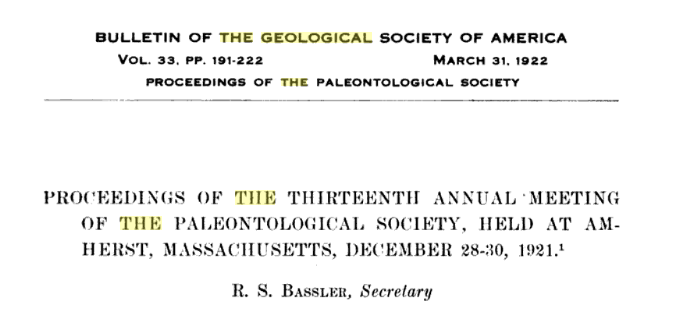
The micropaleontologists, Esther Richards Applin (Rio Bravo Oil), Alva Ellisor (Humble), and Hedwig Kniker (The Texas Company) worked for different oil companies, but shared the same apartment in Houston. Their employers were part of a four-company paleontological consortium originally established by Rio Bravo Oil with the consortium lab headquartered at Rio Bravo. However, other companies of the consortium quickly set up their own labs. The women became pioneers in using microfossils for stratigraphic correlation. They were originally hired to use macrofossils, mollusks primarily, to unravel the stratigraphy of the US Gulf coast. But, they determined that the destruction or only partial recovery of mollusks in well cuttings during drilling was a hindrance. Microfossils, however, provided a solution, and they found foraminifera to be not as unvaried through geologic time as previously believed. Their seminal presentation on Gulf Coast stratigraphic correlation using microfossils was in December 1921 at the 13th annual Paleontological Society meeting, held during the Geological Society of America (GSA) annual meeting in Amherst, Massachusetts. The paper was single-authored by E.T. Dumble of Rio Bravo Oil, founder of the original 4-company paleontology consortium, but was read by Esther Richards, the first consortium paleontologist (she married geologist Applin in 1923).

Richards-Applin also read the preceding paper by eminent male foraminiferal paleontologist, J. A. Cushman, who stood in the back of the room (as recounted by Richards-Applin in Todd, 1985**). Cushman was also coming to the same conclusions as Applin, Ellisor, and Kniker, although it is difficult to determine this from the short entry in the meeting proceedings pictured below. At the end of Richards’ presentation of the Dumble paper, J. J. Galloway of Columbia University condescendingly responded with convictions of the day, both in terms of foram paleontology and women scientists, “Gentlemen, here is this chit of a girl right out of college, telling us that we can use foraminifera to determine the age of formation. Gentlemen, you know it can’t be done.” (Gries, AAPG Explorer, Oct. 2017). Cushman remained silent, despite this challenge (Todd, 1985). Knowing Galloway’s retort, it is interesting to note that while complete abstracts or synopses of talks by other speakers are included in the GSA Bulletin (volume 33), which covered the proceedings of the meeting, the entries pictured below for the two Cushman/Dumble/Richards-Applin talks are frustratingly uninformative and short.  


Entire entry for Cushman and Dumble papers, both read by Esther Richards, Bulletin of the Geological Society of America, vol. 33, "Proceedings of the 13th Annual Meeting of the Paleontological Society" p. 206-207
However, Gries writes that a year later Galloway had changed his mind, and, within 3 years, there were “oil industry jobs for 300 micropaleontologists and . . . micropaleontology courses in 31 geology departments.” Gries reminds us that at this time, the 1920’s, the only subsurface information available in oil exploration was well cuttings. Ruth Todd, herself a "leading figure in the field of foraminiferal research”, did give Richards, Kniker and Ellisor credit for “being among the first” to use forams in oil exploration, in her 1985 biography of Cushman. However, in some histories of the development of micropaleontology, the three pioneering industry micropaleontologists became “Hidden Figures”, with the role of male practitioners highlighted instead (Gries, AAPG Explorer).  

Including the selections on Richards-Applin, Kniker and Ellisor, Gries' book, Anomalies, highlights ~140 women in the earth science field of petroleum geology, covering the 100 years (1917-2017) of AAPG's existence and the early entrée of women geologists into the petroleum industry. The format is a series of biographies and autobiographical statements, ranging in length from half a page to several pages each. Although focusing on women in the petroleum industry, the book is relevant to the career journey, access, and hurdles of professional women and scientists through the 20th century and into the 21st. One hundred of these women were also highlighted on a display wall during both the 2017 AAPG annual meeting and the October annual meeting of the Geological Society of America (Gries is also GSA President-elect, June 2017-18; GSA President, June 2018-19).

Wall of AAPG trail-blazing women at GSA 2017 annual meeting
The biographies are essentially chronological, organized by chapters, with sub-sections, that highlight evolving career challenges through the decades, such as: "1917-1918: The First Female Employees in Petroleum During WWI", . . . "1920s to 1940s: The Micropaleontology Era", . . . "Early Affirmative Action, Diversity, and the Oil Business".

Some may think that title chapters, such as "Women Who Married and Stayed in Industry After the War [World War II]" and "Women Who Married and Had to Quit: Some Became Consultants or Joined A Geologic Survey", are retro, old-fashioned, un-feminist, or not career-centric, but they directly address reality. Whether the Baby Boomer generation of me and Gries' with the limited daycare choices of the early 1970's and little to no paid family leave, or the Millennial generation of my daughter which has more family-friendly options for balancing career with family needs, career decisions can be challenging whether one is in a relationship, with or without children, or is a single-parent.


Anomalies partial Table of Contents and sample biographical entries

Although Anomalies is 390 pages of text, with, as mentioned earlier, ~140 biographies, this is not onerous since the biographies can be read out-of-order and sporadically: great for an empowering coffee table addition, or a guilt-free break at work.

*Robbie Rice Gries
President, Priority Oil & Gas
AAPG President, 2001-02 (first woman to hold that position)
Treasurer, Geological Society of America (2006-09)
Vice President/President-Elect, GSA (2017-19)

** p. 261 in Todd, Ruth, 1985, Joseph A. Cushman and the study of Foraminifera, Geological Society of America Special Centennial volume 1, p. 257-271. 

Links to other online sources in or relevant to this blog post:
https://explorer.aapg.org/issue/articleid/36988/october-2017 (Three Women, One Breakthrough; non-members of AAPG can download whole issue through link at bottom of webpage)

(Memorial to Cushman, with contributions from Esther Richards Applin)

Tuesday, December 12, 2017

WHY THERE WILL BE NO #MaceralCup


This fall (2017) on Twitter, there have been exciting earth-science voting competitions: the iconic and ground-breaking #MinCup (favorite mineral), the subsequent #RockCup, and the recently-ended (November 2017) #DinoCup. Each competition pitted 32 choices, bracketed by pulling "competitors" out of a hat. #MinCup was the brainchild of @tectonictweets (Dr. Eddie Dempsey, structural geology lecturer at the University of Hull, England); #DinoCup is his paleontological follow-up. Picking up the gauntlet, A-level geology at Greenhead College, Huddersfield, England, held the #RockCup. The goal of these geologic social media/ science communication exercises was both fun geology community interaction and to engage/inform students. As @Geol_Greenhead specifically entreated during #RockCup: "help 16-18yr olds engage with geology[:] tell them about the rocks on their A-level specification". Most participants just voted daily, but many promoted their favorites with photos and relevant information about why their mineral, etc, was better than its competitor that day. #TeamGarnet was a particularly vocal, but ultimately vanquished, group during #MinCup (darn olivine). During #DinoCup, I learned, disappointingly, that the true velociraptor was quite small, possibly with feathers, resembling an ugly turkey; deinonychus was the actual model for the Jurassic Park “velociraptors”. 

Garnet by Hazel Gibson

Dempsey summarized the viral 2017 #MinCup experience in his blog (https://eddiedempsey.wordpress.com/2017/10/15/the-first-mincup/), and #MinCup was touted as a science communication success by various outlets. A beautiful legacy of this year’s #MinCup is Dr. Hazel Gibson’s charity calendar (https://mypatchworkplanet.com/mincup-charity-calendar/https://mypatchworkplanet.com/mincup-charity-calendar/) of mineral-contender ink drawings produced during her contemporaneous participation in #Inktober (“31 days, 31 drawings”).


Following in the success of these initial bracketed earth material/fossil competitions are #FaultCup, #VolcanoCup, and #ExoCup (vote for favorite exoplanet so not actually not “earth” science). There may be others of which I am not aware. A suggested competition is #OreCup. While #MinCup, #RockCup, #DinoCup may be annual events and have multitudinous contenders, is it possible, with further new earth-science-based matches, we could get either burned out or too specialized to have much of an audience?

So as a coal petrologist (although very proud of my earlier amphibolite-grade metamorphic roots [Go #TeamGarnet]), I thought what about a competition for favorite maceral: #MaceralCup? First off, many may query, hopefully politely, what is a maceral? Using an analogy, like the much-maligned ones previously common on US college-entrance exams, maceral:coal::mineral:rock. A maceral, as defined initially in 1935 by paleobotanist and coal petrologist Marie Stopes, is a microscopically distinguishable organic component of coal derived from the decomposed and macerated remains of plants. Besides coal, macerals are found dispersed in sedimentary rocks and are petroleum and natural gas precursors. Maceral names end “inite”. (FYI: Stopes, 1880-1958, is most famous for her books on intimate married relations and birth control, highlighted recently during one episode of Downton Abbey.)

However, there will be no #MaceralCup for the following reasons (Spoiler alert: the most important reason is the culminating #3; #1 is lengthy but informative maceral background for the non-organic geologist):

1) There are only about two-dozen macerals defined for bituminous and anthracite coals (Suárez-Ruiz, 2012; complete citation at bottom). This number of macerals is probably not too few for a competition, but tough to add in new competitors in subsequent years. Maceral quantity increases if one includes the alternate names for vitrinite group macerals that are applied at the lower lignite/brown coal ranks (huminite group). For maceral photomicrographs see https://energy.usgs.gov/PhotoAtlas/  .

Just FYI, here are macerals with mostly quick definitions. (Definitions below are my own, or derived from Suárez-Ruiz, ICCP citations below, or the linked Indiana Geological Survey photomicrograph pages.):

LIPTINITE GROUP (a flashy competitive group since these lipid-rich components brilliantly fluoresce yellow to red under UV or blue-light excitation.)
            Sporinite- spores and pollen
            Cutinite- Leaf cuticle, the wax coating of leaves.
            Resinite- Plant resin of various compositions, including the amber of Jurassic Park.
            Alginite- Fossil algae. Can be broken into two subtypes, as described by Hutton (1987): telalginite- from large colonial or unicellular algae; and lamalginite from small thin-walled algae.
            Suberinite- Cell walls of cork
            Chlorophyllinite- Derived from chlorophyll but not present in bituminous and anthracite rank coals (only lignite and subbituminous)
            Fluorinite- This is a subtype of resinite derived from essential oils associated with leaves. Usually found with cutinite, which aids its identification. More intense and yellower epifluorescence than most resinites. This is probably my favorite just because it was always a treat to find it present.
            Bituminite- Fine stringy, filamentous or granular, but essentially unstructured, groundmass from degradation of algae, bacteria or other predominantly autochthonous lacustrine or marine organic matter. Some use “AOM”, amorphous organic matter, interchangeably (me). But, officially the two are not synonymous since a maceral must be a “microscopically recognizable individual constituent” (Pickel et al., 2017), and “AOM” has been used for submicroscopic structureless solid organic matter. “Recognizable” may, however, depend on the magnification (500X-1000X), and discrimination of either bituminite or AOM from a clay matrix in whole rock microscope preparations can be difficult. I personally believe that AOM or bituminite is the same as the fluffy organic component of marine snow. Also bituminite is a confusing name since it can be mixed up by some with the term “solid bitumen” which is a produced hydrocarbon.
            Exudatinite- A secondary crack-filling fluorescing maceral produced during oil generation.
            Liptodetrinite- Liptinite detritus, frequently small, and frequently lacking structural identifiers so source is unknown.
           
Cutinite from Pickel and others (2017)


Darker-orange-fluorescing cutinite (long serrated) enclosing non-fluorescing phyllovitrinite and bright-yellow-fluorescing fluorinite. Yellow "liptodetrinite and sporinite in surrounding matrix". From Pickel and others (2017).

VITRINITE GROUP (The primary, and most abundant, maceral group in most coals, derived from woody tissue of stems, roots and leaves. Vitreous luster. The predictable increase in reflectivity of telinite with increasing diagenesis, “vitrinite reflectance”, is a commonly used very-low-grade-metamorphic indicator. )
            Telovitrinite subgroup- In this group, the maceral telinite is identified clearly by preservation of woody cellular structure; in collotelinite, texture is more homogeneous with cell walls possibly only barely visible.
            Detrovitrinite subgroup- Vitrodetrinite is small vitrinite detritus. Collodetrinite: gelified vitrinite groundmass binding other macerals (like the gelatin of a fruited Jello (or jelly to you Brits) salad).
            Gelovitrinite- This subgroup is colloidal vitrinitic filling in voids: corpogelinite (discrete bodies between woody plant cell walls); gelinite (gelified vitrinitic fillings of other voids/cracks).
 
Reflected white-light oil-immersion microscopic image showing various macerals.
INERTINITE GROUP (These macerals are generally “inert” in industrial processes like coke-making for the steel industry. All higher reflectance than vitrinite. Many are the products of combustion in ancient widlfires. )
            Fusinite- Classic high-reflectance open-cell (cell walls but empty lumens) charcoal structure.
            Semifusinite- Lower reflectance than fusinite indicating possible lower temperature of combustion. Sometimes fossilized burnt tree trunks or branches show a gradation from fusinite exterior to semifusinite interior.
            Funginite- Highly-reflecting fungal remains.
            Secretinite- Oxidized resin or gel, no plant structures, frequently rounded.
            Macrinite- Structureless, no definite shape, but commonly elongated and high reflectance.
            Micrinite- Tiny, high reflectance, granular maceral. May be residue of AOM or other liptinites after oil generation.
            Inertodetrinite- Small highly-reflecting detritus that cannot be assigned to any of the inertinite groups.
           

2) Personally, some of my favorite macerals are not recognized officially by the ICCP (International Committee for Coal and Organic Petrology, governing body of coal petrographic terminology, www.iccop.org) so would sadly not be contenders. Like #1, this does not preclude a competition but limits competitors:
a) Algodetrinite: This is liptinite detritus derived exclusively from algae. The term was suggested by Adrian Hutton, but he stated that the general official term liptodetrinite should supercede. However, if the goal of a maceral count study is documenting land plant vs. lacustrine/marine organic contribution, the provenance-neutral liptodetrinite is not a useful category if the detritus is clearly algal-derived.
b) Pseudovitrinite- An oxidized, slightly higher reflecting, variety of telinite showing remnant cell structure and tell-tale slits. First described by Benedict and others (1968) of Bethlehem Steel; determining volume percent is a useful predictor of coal behavior in the coking process.
c) Phyllovitrinite- Woody or lignin-cellulose material in leaves. Not listed as an official definition, but a useful descriptor when found enclosed by cutinite.


3) MOST IMPORTANTLY---There will be no #MaceralCup because THERE ARE HARDLY ANY COAL (OR ORGANIC) PETROLOGISTS ON TWITTER!!! I know only a FEW coal-petrology trained geologists on Twitter. One petrologist's research concentration is palynology.  Although I have run into other palynologists on Twitter, not all palynologists (specialists in taxonomic identification of modern and fossil spores and pollen) are trained also in coal/organic petrology and lingo. The other Twitter-savvy organic petrologists, of whom I am aware, specialize in modern and ancient wildfire research, all part of or graduates of the same research group. I searched for names of colleagues and board members in organic petrology professional societies and came up empty. Are there younger organic petrologists I haven’t found? While there would obviously be a spirited debate between #TeamSporinite and #TeamFusinite with the current 7-8 organic petrologists on Twitter, one cannot have an informative, mind-expanding, educational Twitter exchange if no one else is out there.  WHERE ARE YOU ALL??

Citations:
Benedict, L. G., Thompson, R. R., Shigo, J. J. III, Aikman, R. P., 1968, Pseudovitrinite in Appalachian coking coal: Fuel, v. 47, no. 2, p. 125-143.

Hutton, A. C., 1987, Petrographic class of oil shales: International Journal of Coal Geology, v. 8, p. 203- 31.

International Committee on Coal and Organic Petrology, 1998, The new vitrinite classification (ICCP System 1994): Fuel, v. 77, no. 5, p. 349-358.

International Committee on Coal and Organic Petrology, 2001, The new inertinite classification (ICCP System 1994): Fuel, v. 80, no. 4, p. 459-471.

Pickel, W., and others, 2017, Classification of liptinite—ICCP System 1994: International Journal of Coal Geology, v. 169, p. 40-61 (http://ogs.ou.edu/docs/articles/IJCG-V169-P40-61.pdf )

Stopes, Marie, 1935, On the petrology of banded bituminous coals: Fuel in Sci. and Pract., Vol. 14, p. 4-13.

Suárez-Ruiz, Isabel (2012), Organic petrology: An overview, in Al-Juboury, Ali (ed.), Petrology- New perspectives and applications: InTech (http://www.intechopen.com/books/petrology-new-perspectives-and-applications/organic-petrology-an-overview)

Other organic petrology resources see http://carbonacea.blogspot.com/2015/06/coal-and-organic-petrology.html

Thursday, April 20, 2017

Scientist jobs that don’t include teaching or research . . .


At the recent 2017 Northeast/North Central joint section meeting of the Geological Society of America, I ran into a thirty-something alumnae of my undergraduate college who had finished her Ph.D. in geology in 2009. I first met this woman on a metamorphic-geology field trip several years ago while she was still a grad student. It was great to see her again and catch up. She told me she is STEM coordinator and adviser for a leadership scholars program at a major university, but was apologetic that it was not a position actually doing science. I said no apology needed! What a better adviser for students considering STEM (science-technology-engineering-math) careers than someone who has done science research and personally navigated undergraduate and graduate science education?

This interaction also reminded me of grad school classmate who, just before finishing her dissertation at what is a major research institution, felt she was sensing disapproval from faculty for expressing an interest in post-grad academic positions that focused mostly on teaching and little on research. But there is not just one valid career path for persons educated as scientists or engineers: teaching, research, advising/consulting, academic or corporate leadership, public policy are among possible pathways, depending on one’s talents, interests, and opportunities.

Teaching science includes a range of university (post-secondary) positions from those at top-tier research institutions to community and junior college. Research may be an essential part of many university departments and a requirement for tenure; directing student research is an important component. However, at institutions such as community colleges, teaching may be the major or sole job requirement with limited opportunities for one’s own or student research. However, that does not diminish the important task of educating the students on the methodology of science, its role in society, and the specifics of the science field chosen for a major or distributive course requirement.  In addition, science education begins way before college: science subject K-12 teacher certifications start at the middle school level (~age 10), if not before.

Careers that have science as a base, whether one has a bachelor’s, Master’s, or Ph.D. degree in a science field, are numerous and varied. Teaching is only one career line. Those who do research or applied science work for a variety of institutions: academia, industry, government. Some scientists or engineers in industry, as they advance their careers, may transition into a corporate leadership track (example: Rex Tillerson, engineer and former CEO of ExxonMobil). In academia and government, those who start in research and/or teaching may choose to advance to institutional administration.

Scientists have also made career transitions into public policy, working for non-profit science institutions, as staff for elected representatives, or themselves holding elected or appointed government leadership roles. In the US, Congressional Science Fellowship programs sponsored by many professional scientific societies, under the oversight of AAAS, is one avenue to participate in public policy for a year or a basis to make a permanent transition into public policy. One could also apply directly for Congressional staff jobs through the US Senate employment office or the equivalent in the House of Representatives. AAAS and some other scientific societies have fellowships in other government agencies.

Science communication is a career path where a science background is a plus. Some professional societies (American Geosciences Institute, AGI; American Geophysical Union, AGU; American Association for the Advancement of Science, AAAS) offer media internships or fellowships. University schools of journalism, like at Columbia and Missouri, may have concentrations in science and/or environmental writing.

It was recently pointed out in an opinion piece in the AAPG Explorer (March 2017) by AAPG (American Association of Petroleum Geologists) Executive Director David Curtiss that General Colin Powell was an undergraduate geology major.

     He “completed his degree in geology from City College of New York and was immediately sworn in as a second lieutenant in the U.S. Army. He never worked as a geologist. But, . . . his knowledge of geology and how the Earth works informed his entire career. Whether it was moving troops over rugged terrain or the delicate balancing act of the geopolitics of oil and natural gas, his understanding of the planet helped him navigate these challenges. If ever there was an endorsement for studying the geosciences – even if you want to pursue a career outside of traditional geological professions – look no further than Colin Powell.

So don’t be ashamed of whatever career path you take after getting a science degree! Your best contribution will be in a job that makes you happy.

Below is a limited list of scientists who made career choices where they eventually were not teaching science or doing research:

Rush Holt- physicist, former Congressman, CEO American Association for the Advancement of Science (AAAS)

Harrison Schmidt- Geologist, Astronaut (Apollo 17), Senator (1977-1983)

Joanne Liu- President of Doctors Without Borders/Médecins Sans Frontières (MSF),

Marcia McNutt, Director, US Geological Survey (2009-2013); President, National Academy of Sciences

Melody Brown Burkins- Congressional Science Fellow (1999-2000); US delegation chair, 2016 International Geologic Congress (IGC); Director for Programs and Research of The John Sloan Dickey Center for International Understanding and Adjunct Professor of Environmental Studies (ENVS), Dartmouth College

Steven Chu- Physicist, Nobel Prize winner, US Secretary of Energy (2009-2013)

Ernest Moniz- Physicist, US Secretary of Energy (2013-2017)

Maria Honeycutt- Congressional Science Fellow (2007-2008), Coastal hazards policy analyst (NOAA)

Kevin Wheeler- USAID, science and international development consulting

David Curtiss- Congressional Science Fellow (2001-2002); Executive Director, AAPG

Wendy Hill- Neuroscientist and Provost, Lafayette College (to 2014); Head, Agnes Irwin School (private secondary school)