Monday, February 11, 2019

Bethlehem Steel 1: Virtual tour of the blast furnaces along Hoover-Mason trestle walkway


This summer (2018), arriving early for a movie at the ArtsQuest Center at SteelStacks https://www.steelstacks.org/ in Bethlehem, Pennsylvania, I was surprised to see the elevated walkway over the old trestle right in front of the majestic row of closed Bethlehem Steel blast furnaces across from the arts venue. (Steel making in Bethlehem ceased in 1995, and the expansive industrial property along the Lehigh River has been repurposed as an arts/entertainment/retail center.) The walkway with educational signs about the blast furnaces and related steelmaking process has been there since about 2013, but somehow, big events or bad weather kept me from noticing it before. 

Not sure when in my life I first heard of Bethlehem Steel: definitely by the time my youngest sister attended Lehigh University, an engineering and liberal arts school, just up the hill from the steel works in Bethlehem. She would mention the huge completed I-beams that would tie up traffic as they tried to make their way out of town.

Eleven years after her graduation, we moved to Easton, immediately east of Bethlehem and the smallest of the Lehigh Valley’s three cities: Allentown, Bethlehem, Easton. Although non-local media outlets sometimes call the area “Philadelphia suburbs”, and many do commute daily 50-60 miles to Philadelphia, we are also 65 miles straight due west of New York City with a significant population commuting to the “Big Apple”. Scranton/Wilkes Barre in the northern anthracite belt is ~75 miles north. The Lehigh Valley during colonial and growing industrialization of the 19th century became an industrial hub due to river and canal access along the Lehigh and Delaware rivers connecting the anthracite fields, markets of Philadelphia/NYC, and its own mills and factories. Steelmaking began in Bethlehem in the mid-1800’s.

Prior to moving to the Lehigh Valley, we lived in Carbondale, Illinois, where I worked part-time in the coal petrology lab, Geology Department, Southern Illinois University. The lab director, from whom I also took courses in Coal Petrology and Advanced Coal Petrology, had worked several years in the Bethlehem Steel research labs characterizing coals for coke-making and specific parameters that would well-predict the behavior of a coal in both coke ovens and the resultant coke in the blast furnaces.

I was fortunate to get a tour of Bethlehem Steel works in 1990 while it was still operating. We visited the Basic Oxygen Furnace and a rolling mill, escorted by a retired employee. And a few years later, on a grad school field trip to various outcrops of the Late Triassic Lockatong lacustrine black shales of the Newark basin, we ended up in New Jersey right under the George Washington Bridge (crossing the Hudson River between New York City and New Jersey) with Bethlehem Steel boldly stamped on the lower girders of the west suspension tower.

So here is a virtual tour of the blast furnaces along the Hoover-Mason Trestle walkway at the eponymous site of Bethlehem Steel. (All photos without citation are by me.):

Figure 1A: Map- Bethworks master plan (~2013) for transforming the Bethlehem Steel site to arts/entertainment area from http://stream-hugger.blogspot.com/2013/01/going-brown-when-going-green-is-bad.html http://stream-hugger.blogspot.com/2013/01/going-brown-when-going-green-is-bad.html . The blast furnaces are in light brown at the central north of the map, bordering the Lehigh River (click to enlarge).

Figure 1B: Map- Bethlehem Steel works from 1979. Note location of brown-colored ore yard (now Sands Casino), red basic oxygen furnace on right (now industrial park), red blast furnaces (center).

Figure 2: General diagram of a blast furnace operation (Dong, 2008*).

Figure 3:  Bethlehem Steel blast furnaces looking east. There are 5 blast furnaces, A-E (see Figure 1B). The A furnace is the three-stack one on the left. Brick building on the left is the Visitors Center; in the center of the photo are the steps up to the Hoover-Mason Trestle walkway.

Figure 4: Blast furnace row looking west. One can see the silver-gray tourist walkway over the remnants of the Hoover-Mason railroad trestle used to transport materials to furnaces. Canopy structures at the lower left edge of the photo are part of the Leavitt Pavilion outdoor concert venue.

Figure 5: Staircase up to trestle walkway, right in front of blast furnace A. According to AbandonedAmerica, “the oldest furnace is blast furnace A, which was built in 1914. It was rebuilt in 1950 and last ran in 1960. Because of its location directly beside another blast furnace (B, which ran into the 1980s), active mill buildings, and a busy mainline railroad, it was never demolished. ‘A’ furnace is notable because it is the only surviving blast furnace in the United States that still has triple pass stoves”.

Figure 6: Looking east from west end of elevated walkway.

Figure 7: Educational diagram on walkway showing relationship of blast furnace to trestle and explaining the transportation and charging of furnace with the three “ingredients”: coke, limestone, and iron ore. Coke is a vesiculated elemental carbon solid produced by cooking bituminous coal in ovens at high temperature.

Figure 8: Close-up of walkway, trestle, and old trestle car, looking west toward blast furnace A.

Figure 9: Trestle route map. The coke works were about 2 1/2 miles ESE of the blast furnaces; the Sands Casino was built over the old ore pits, half mile east of furnaces (see Figure 1B map).

Figure 10: Blast furnace with skip track used for hauling materials to load at top of furnace.

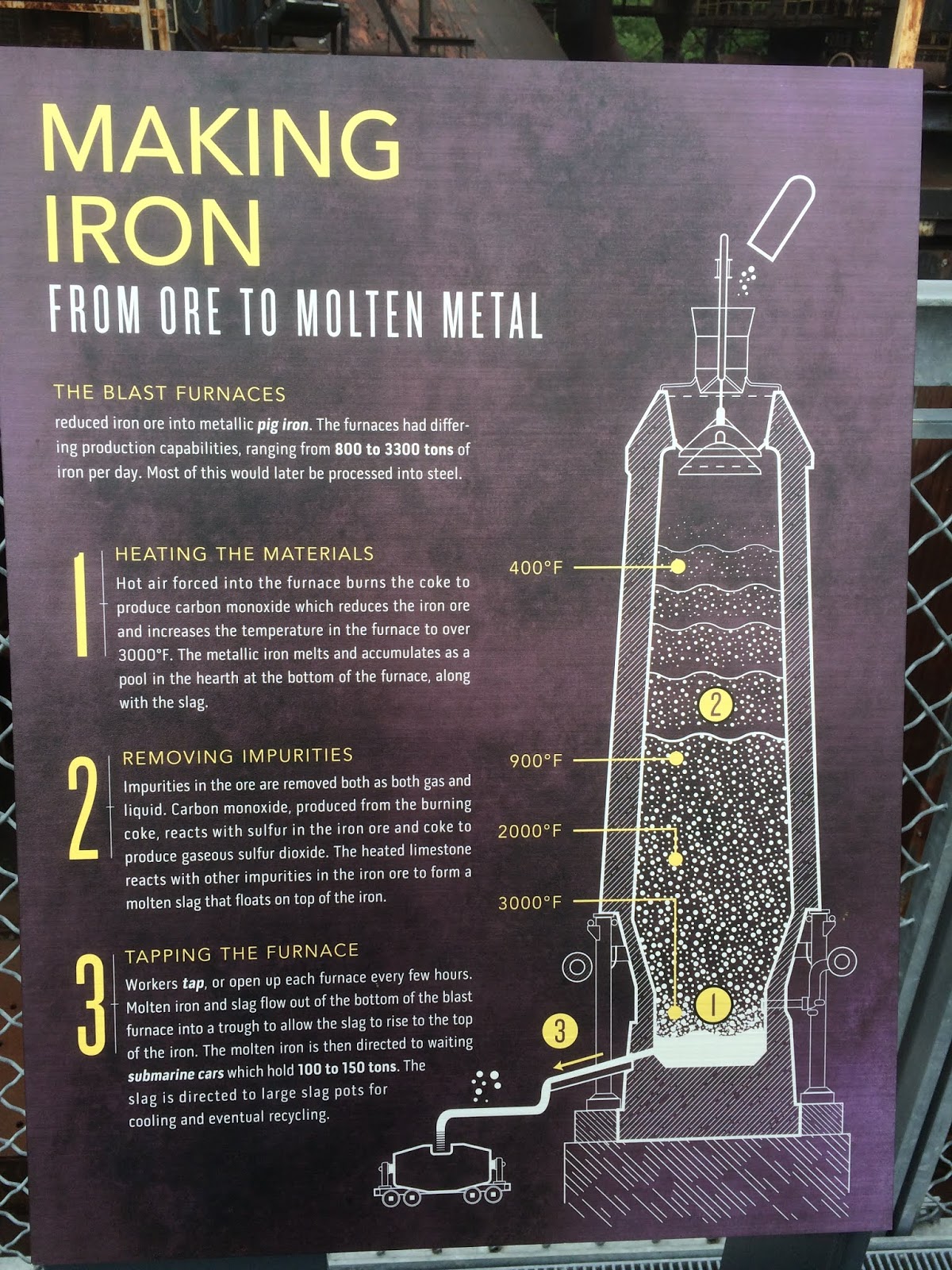
Figure 11: Sign explaining materials layering in blast furnace and transformation of iron-oxide ore to metallic reduced pig iron (which has about 4% carbon).

Figure 12: Working at a blast furnace, Bethlehem Steel, Sparrows Point, Maryland, 1951 (Baltimore Sun)

Figure 13: The basic oxygen furnace (BOF) at Bethlehem. In a BOF, recycled steel or other additives can be added to pig iron from the blast furnace. The BOF at Bethlehem was just west of the current casino (old ore pit location), but has been demolished, replaced by an industrial park (see also map of Figure 1B). (Photo: Hagley Museum collection)

Figure 14: Panoramic shot, looking west, with Hoover-Mason Trestle walkway and blast furnaces on the right (north) and the ArtsQuest concert/movie venue, on the left, that includes studios and offices of the local Public Broadcasting station.

Figure 15: Relict stone walls of iron foundry (background) and possibly old plate shop (foreground), just west of blast furnaces. (Based on map 1B and truck dock legend at http://www.brokenbushandroundtop.com/bethlehemsteel/bethmap_page.html .)

Figure 16: From 2014, leaving Christkindlmarkt, an annual German-tradition Christmas craft market in Bethlehem, the “Christmas City”.  For the last several years, the market has been located at the west end of the “SteelStacks” behind and next to the Visitors Center.
Figure 17: Blast furnace A illuminated at night.

To finish your virtual visit, there is a great DRONE FLYOVER of the SteelStacks from 2016 on YouTube at https://www.youtube.com/watch?v=1HPwX4pB_Qo .

* Citation for Figure 2 diagram: Dong, Shan Ning, 2008, Development of Analytical Methods for Characterizing Metallurgical Coke and the Injectant Coal Chars, Tars and Soots Formed during Blast Furnace Operation (dissertation), Department of Chemical Engineering
, Imperial College London of Science, Technology and Medicine, 204 pages (Figure 2-1) (https://spiral.imperial.ac.uk/bitstream/10044/1/1329/1/Dong-SN-2008-PhD-Thesis.pdf )


Wednesday, November 28, 2018

Lepidodendron (scale trees): Link to great blog post on these Carboniferous giants


At the time of this writing, the wallpaper of my blog is a snapshot of Lepidodendron bark. Lepidodendron is an extinct genus of Carboniferous age (358.9-298.9 million years ago [Ma]) giant trees (AKA scale trees) common in swamps that eventually were preserved as major coal deposits. Its stylized bark is quite artistically attractive, rather Art Deco in design.

Yesterday I read a great informative blog post on Lepidodendron (http://www.indefenseofplants.com/blog/2018/11/13/the-rise-and-fall-of-the-scale-trees), describing the growth, reproduction, habitat, and demise of these majestic (100 foot/ 30 meter) land plants. The post includes origin of the bark design:
“The name ‘scale tree’ stems from the fossilized remains of their bark, which resembles reptile skin more than it does anything botanical. Fossilized trunk and stem casts are adorned with diamond shaped impressions arranged in rows of ascending spirals. These are not scales, of course, but rather they are leaf scars. In life, scale trees were adorned with long, needle-like leaves, each with a single vein for plumbing. Before they started branching, young trees would have resembled a bushy, green bottle brush.”

That blog post also includes a very sharp photo of Lepidodendron bark, the roots with their own fascinating pattern (stigmaria), and drawings of Lepidodendron species, growth stages, and forest environment.

Below are two photos I took of Lepidodendron for my blog wallpaper. The sample is in the mineralogy collection of the Department of Geology and Environmental Geosciences, Lafayette College, Easton, Pennsylvania. The sample is from the Llewellyn Formation, the younger of two Pennsylvanian-age coal-bearing formations (older= Pottsville Formation) in the eastern Pennsylvania anthracite coalfields. The Pennsylvanian subsystem (323.2-298.9Ma) is the term for the late Carboniferous in North America. The Llewellyn itself was deposited between 308-300 Ma. The Llewellyn Formation also contains the famous St. Clair fossil fern locality. 


For an academic, rather than chatty, description of the St. Clair fossil locality (plus anthracite region mining, stratigraphy, fossils), I recommend two guidebooks: 1) 2015 guidebook to the Southern and Western Anthracite Fields by the Field Conference of Pennsylvania Geologists; Stop 12, page 237, is the St. Clair fossil site; 2) 1992 The Society for Organic Petrology (TSOP) guidebook to The Anthracite Basins of Eastern Pennsylvania (USGS Open File Report #92-568; (https://pubs.usgs.gov/of/1992/0568/report.pdf)); the St. Clair locality is Stop 5, page 65. Both guidebooks include references to Lepidodendron throughout.

Friday, November 9, 2018

Mineral sublimates on steaming culm (coal waste) heaps in NE Pennsylvania: one of Dr. Robert Finkelman’s (USGS) contributions in a career on trace element chemistry in coal


I have been aware of mineral sublimates (materials or minerals formed by direct solid deposition from gas) for a long time from research of friends and colleagues at Dartmouth College on fumarolic sublimates at Izalco volcano in El Salvador. Early collection of minerals there occurred in the 1960’s before and after the 1966 eruption of Izalco*. Vanadates and copper vanadate minerals were found among the sublimates, including several newly identified minerals. For a few of the new sublimates, I, having microscope reflectance measurement experience through coal petrography work, contributed the mineral reflectivity data required for naming new opaque minerals.**

Izalco volcano, El Salvador (this photo and one below from Smithsonian Institution Global Volcanism Program)


On Monday, November 5, 2017, at the annual meeting of the Geological Society of America, I attended the initial biographical presentation by Dr. Harvey Belkin in a session honoring Bob Finkelman (US Geological Survey) for his career in inorganic trace element chemistry of coals and related contributions to the understanding health issues of trace element exposure during mining or home coal use.

Belkin related that one of Finkelman’s early publications (1987; citation below) was on his description of new mineral, downeyite, the first confirmed natural occurrence of selenium oxide. Downeyite is a sublimate formed near a hot gas vent, but not at a volcano: it was found on a burning culm heap in the Northern Anthracite field of Pennsylvania! Piled coal or coal waste can smolder or spontaneously combust. I previously wrote in 2015 about culm heap fires in northeastern Pennsylvania, and evidence that a coal fire in one of the coal bunkers on the Titanic was a possible reason for the speed of passage (easiest way to stop a bunker coal fire is to shovel down and use up coal).

Fell Township, PA, coal waste dump fire, February 2014. (The Scranton Times-Tribune)

Forestville coal dump where downeyite first found. (From PA Geological Survey, Mineral Resource Report 78, 1980)

Downeyite is acicular, colorless and extremely hygroscopic, so, as described in Finkelman and Mrose (1977), must be immediately put in a desiccator upon removal from the hot dry vent environment. Temperatures where downeyite was deposited were 190-230˚C.   Over twenty other minerals found at “anthracite smokers”, as vents of hot gas on culm heaps or over underground mine fires are called (Stracher, 1995), are detailed in Pennsylvania Geologic Survey Mineral Resource Report 78 (citation and download link below), including crystals of elemental selenium. That report indeed does cite the similar occurrence of sublimates at volcanic fumaroles including Izalco!


(From PA Geological Survey, Mineral Resource Report 78, 1980)


Finkelman, “Anthracite smoker” references

Finkelman, R. B., Mrose, M. E., 1977, Downeyite, the first verified natural occurrence of SeO2: American Mineralogist, v. 62, n. 3-4, p. 316-320. (https://pubs.geoscienceworld.org/msa/ammin/article-abstract/62/3-4/316/40741/downeyite-the-first-verified-natural-occurrence-of?redirectedFrom=fulltext)

Finkelman, Robert B., Belkin, Harvey E., and Zheng, Baoshan, 1999, Health impacts of domestic coal use in China: Proceedings of the National Academy of Sciences USA (PNAS), http://www.pnas.org/content/96/7/3427)

Lapham, Davis M., Barnes, John H., Downey, Wayne F., Jr., Finkelman, Robert B., 1980, Mineralogy associate with burning anthracite deposits of Eastern Pennsylvania: Mineral Resource Report 78, Pennsylvania Geological Survey, Fourth Series, Harrisburg, 92 pages. (Can download from this page- scroll down to “M 78”: http://www.docs.dcnr.pa.gov/topogeo/publications/pgspub/mineral/index.htm )

Stracher, Glenn, B., 1995, The anthracite smokers of eastern Pennsylvania: PS2(g) -T stability diagram by TL analysis: Mathematical Geology, v. 7, n. 4, p. 499-511 (https://link.springer.com/article/10.1007/BF02084424)

Izalco references

*Rose, W. I., Stoiber, R. E., 1969, The 1966 eruption of Izalco Volcano, El Salvador: Journal of Geophysical Research, v. 74, n. 12, p. 3119- 3130.

Stoiber, R. E., Rose, W. I., Jr., 1974, Fumarole incrustations at active Central American volcanoes: Geochimica et Cosmochimica Acta, v. 38, p. 495-516.

**Hughes, J. M., Drexler, J. W., Campana, C. F., Malinconico, M. L., 1988, Howardevansite, (Na, K)CuFe2(VO4)3, a new fumarolic sublimate from Izalco Volcano, El Salvador, Descriptive mineralogy and crystal structure: American Mineralogist, v. 73, p. 181-186.

Hughes, J. M., Starkey, S., Malinconico, M. L., and Malinconico, L. L., Jr., 1987, Lyonsite, Cu3Fe4(VO4)O6, a new fumarolic sublimate from Izalco Volcano, El Salvador, Descriptive mineralogy and crystal structure: American Mineralogist, v. 72, p. 1000-1005.

Robinson, P. D., Hughes, J. M., Malinconico, M. L., 1987, Blossite, alpha-Cu 2V2O7, a new fumarolic sublimate from Izalco Volcano, El Salvador, Descriptive mineralogy and crystal structure: American Mineralogist, v. 72, p. 397-400.

Thursday, March 8, 2018

Pioneering Women in (Petroleum) Geology: 2017 professional society events and "Anomalies" by Robbie Rice Gries


Among featured events last April at the 2017 annual convention of the American Association of Petroleum Geologists (AAPG), celebrating the society's 100th anniversary, was the women's forum, "Pioneering Women in Petroleum Geology: 100 years" sponsored by PROWESS (PROfessional Women in Earth ScienceS); a talk by Robbie Rice Gries*, first woman AAPG President (2001-02), in the History of Petroleum Geology symposium; and a signing event for Gries' book, Anomalies: Pioneering Women in Petroleum Geology, 1917-2017.
 
Robbie Rice Gries signing copies of her book, Anomalies, at the AAPG Exhibit booth during Geological Society of America annual meeting, October 2017 (photo by AAPG on Twitter)
I missed the symposium, attending in a short course instead, but enjoyed Gries' subsequent talk, "Three Women Provide the Profound Exploration Technology Breakthrough of the 1920s", on three oil-company micropaleontologists working in the Gulf coast in the 1920's. Gries’ also wrote biographies of the three women in Anomalies and in an article, Three Women, One Breakthrough, in the October 2017 AAPG Explorer (starting page 20).

My drawing of planktonic microfossil Globigerina from a lab exercise in graduate carbonate petrology class, Southern Illinois University, 1987
 
The micropaleontologists, Esther Richards Applin (Rio Bravo Oil), Alva Ellisor (Humble), and Hedwig Kniker (The Texas Company) worked for different oil companies, but shared the same apartment in Houston. Their employers were part of a four-company paleontological consortium originally established by Rio Bravo Oil with the consortium lab headquartered at Rio Bravo. However, other companies of the consortium quickly set up their own labs. The women became pioneers in using microfossils for stratigraphic correlation. They were originally hired to use macrofossils, mollusks primarily, to unravel the stratigraphy of the US Gulf coast. But, they determined that the destruction or only partial recovery of mollusks in well cuttings during drilling was a hindrance. Microfossils, however, provided a solution, and they found foraminifera to be not as unvaried through geologic time as previously believed. Their seminal presentation on Gulf Coast stratigraphic correlation using microfossils was in December 1921 at the 13th annual Paleontological Society meeting, held during the Geological Society of America (GSA) annual meeting in Amherst, Massachusetts. The paper was single-authored by E.T. Dumble of Rio Bravo Oil, founder of the original 4-company paleontology consortium, but was read by Esther Richards, the first consortium paleontologist (she married geologist Applin in 1923).

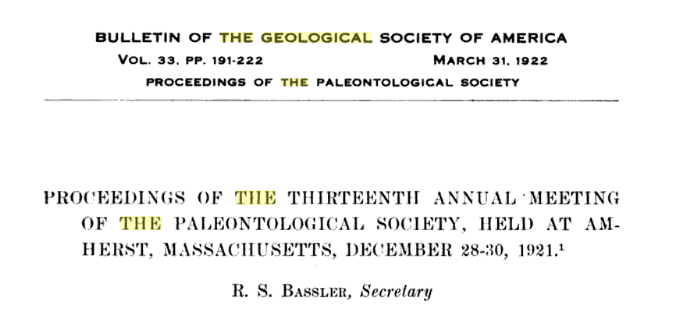
Richards-Applin also read the preceding paper by eminent male foraminiferal paleontologist, J. A. Cushman, who stood in the back of the room (as recounted by Richards-Applin in Todd, 1985**). Cushman was also coming to the same conclusions as Applin, Ellisor, and Kniker, although it is difficult to determine this from the short entry in the meeting proceedings pictured below. At the end of Richards’ presentation of the Dumble paper, J. J. Galloway of Columbia University condescendingly responded with convictions of the day, both in terms of foram paleontology and women scientists, “Gentlemen, here is this chit of a girl right out of college, telling us that we can use foraminifera to determine the age of formation. Gentlemen, you know it can’t be done.” (Gries, AAPG Explorer, Oct. 2017). Cushman remained silent, despite this challenge (Todd, 1985). Knowing Galloway’s retort, it is interesting to note that while complete abstracts or synopses of talks by other speakers are included in the GSA Bulletin (volume 33), which covered the proceedings of the meeting, the entries pictured below for the two Cushman/Dumble/Richards-Applin talks are frustratingly uninformative and short.  


Entire entry for Cushman and Dumble papers, both read by Esther Richards, Bulletin of the Geological Society of America, vol. 33, "Proceedings of the 13th Annual Meeting of the Paleontological Society" p. 206-207
However, Gries writes that a year later Galloway had changed his mind, and, within 3 years, there were “oil industry jobs for 300 micropaleontologists and . . . micropaleontology courses in 31 geology departments.” Gries reminds us that at this time, the 1920’s, the only subsurface information available in oil exploration was well cuttings. Ruth Todd, herself a "leading figure in the field of foraminiferal research”, did give Richards, Kniker and Ellisor credit for “being among the first” to use forams in oil exploration, in her 1985 biography of Cushman. However, in some histories of the development of micropaleontology, the three pioneering industry micropaleontologists became “Hidden Figures”, with the role of male practitioners highlighted instead (Gries, AAPG Explorer).  

Including the selections on Richards-Applin, Kniker and Ellisor, Gries' book, Anomalies, highlights ~140 women in the earth science field of petroleum geology, covering the 100 years (1917-2017) of AAPG's existence and the early entrée of women geologists into the petroleum industry. The format is a series of biographies and autobiographical statements, ranging in length from half a page to several pages each. Although focusing on women in the petroleum industry, the book is relevant to the career journey, access, and hurdles of professional women and scientists through the 20th century and into the 21st. One hundred of these women were also highlighted on a display wall during both the 2017 AAPG annual meeting and the October annual meeting of the Geological Society of America (Gries is also GSA President-elect, June 2017-18; GSA President, June 2018-19).

Wall of AAPG trail-blazing women at GSA 2017 annual meeting
The biographies are essentially chronological, organized by chapters, with sub-sections, that highlight evolving career challenges through the decades, such as: "1917-1918: The First Female Employees in Petroleum During WWI", . . . "1920s to 1940s: The Micropaleontology Era", . . . "Early Affirmative Action, Diversity, and the Oil Business".

Some may think that title chapters, such as "Women Who Married and Stayed in Industry After the War [World War II]" and "Women Who Married and Had to Quit: Some Became Consultants or Joined A Geologic Survey", are retro, old-fashioned, un-feminist, or not career-centric, but they directly address reality. Whether the Baby Boomer generation of me and Gries' with the limited daycare choices of the early 1970's and little to no paid family leave, or the Millennial generation of my daughter which has more family-friendly options for balancing career with family needs, career decisions can be challenging whether one is in a relationship, with or without children, or is a single-parent.


Anomalies partial Table of Contents and sample biographical entries

Although Anomalies is 390 pages of text, with, as mentioned earlier, ~140 biographies, this is not onerous since the biographies can be read out-of-order and sporadically: great for an empowering coffee table addition, or a guilt-free break at work.

*Robbie Rice Gries
President, Priority Oil & Gas
AAPG President, 2001-02 (first woman to hold that position)
Treasurer, Geological Society of America (2006-09)
Vice President/President-Elect, GSA (2017-19)

** p. 261 in Todd, Ruth, 1985, Joseph A. Cushman and the study of Foraminifera, Geological Society of America Special Centennial volume 1, p. 257-271. 

Links to other online sources in or relevant to this blog post:
https://explorer.aapg.org/issue/articleid/36988/october-2017 (Three Women, One Breakthrough; non-members of AAPG can download whole issue through link at bottom of webpage)

(Memorial to Cushman, with contributions from Esther Richards Applin)